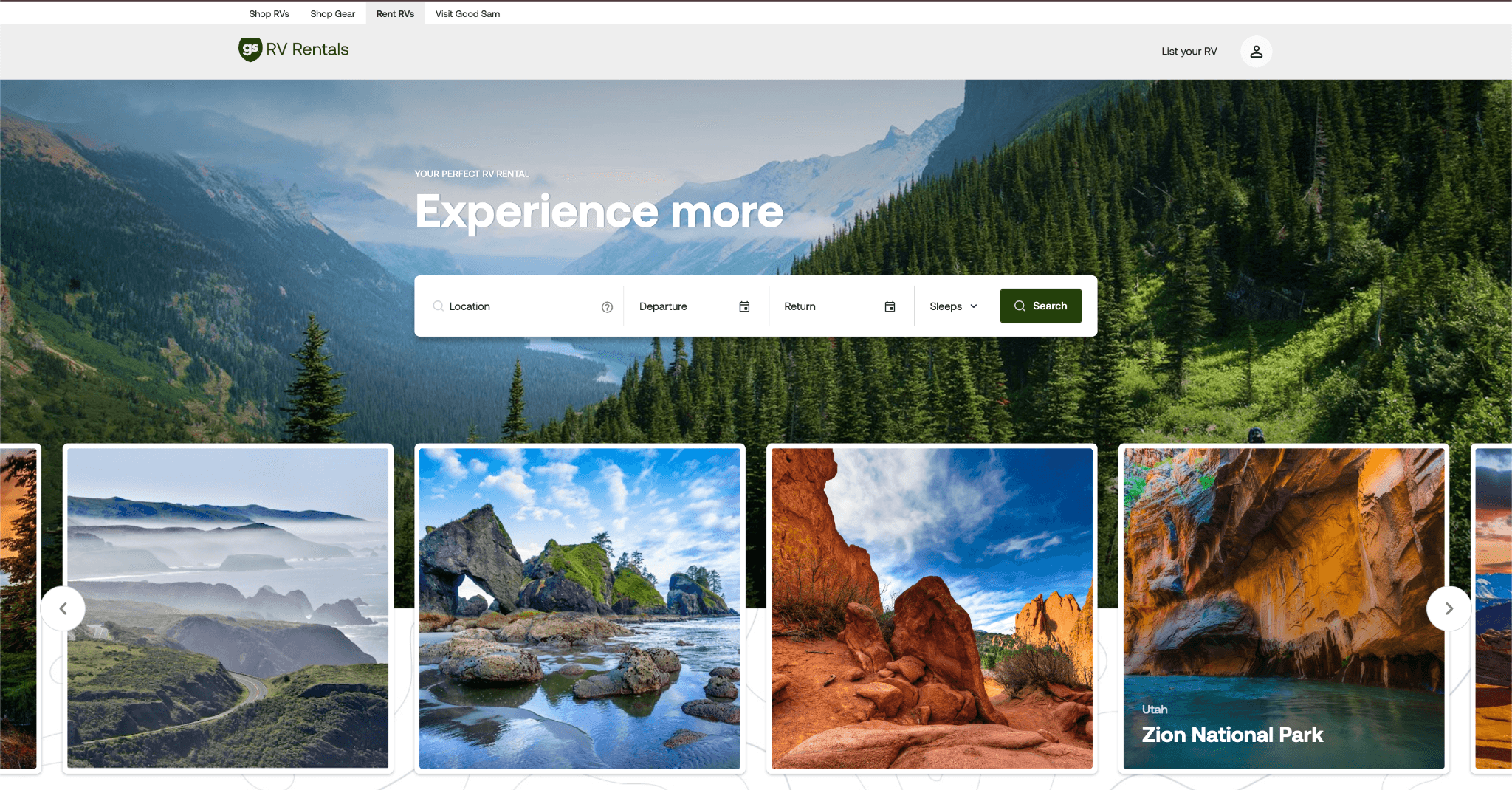
RV Rentals is a travel platform that helps people discover rental vehicles and plan road trips across the US through a modern search and booking experience. Travellers compare vehicles by location, dates and features, then book without leaving the site. For a marketplace like this, a slow or confusing search page means a lost booking, and a page search engines cannot read means fewer travellers arrive at all.
I built user-facing product features with Next.js, React.js, TypeScript, GraphQL and Effector, and contributed to a frontend architecture that kept search and booking maintainable as the product grew. I worked on the flows travellers spend the most time in: search, listing details and booking.
Search with many filters that never falls out of sync
Situation
A traveller can change location, dates, vehicle type and features in any order, while the list and the map both have to reflect the same result set. When filter state lives in several places, the map and the list quietly start to disagree.
How I handled it
I kept search and booking state in Effector stores with explicit events, so every filter change flows through one place and both the list and the map read from it. GraphQL queries were built from that state and requested only the fields each view needed.
Outcome
Predictable search behaviour whatever order the user changes things in, and a state model new team members could follow without reading every component.
- State architecture
- Effector
- GraphQL
- Maintainability
Fast, indexable listing pages
Situation
Most travellers find a rental through a search engine. Pages that render only in the browser load slowly on mobile and are harder for search engines to index, which hurts a marketplace twice.
How I handled it
I built listing and search pages with server-side rendering in Next.js, so the first view arrives with real content, and kept client-side interactivity for filtering and booking on top of it.
Outcome
Pages that load with content on the first request and give search engines something to index.
- Next.js SSR
- Performance
- SEO awareness
A booking flow without friction
Situation
Choosing dates, checking availability and confirming a booking is the moment that earns the business money, and every unclear step in it costs bookings.
How I handled it
I worked on the booking flow UX together with design, kept each step's state explicit so users could go back without losing choices, and surfaced availability clearly before the user committed.
Outcome
A booking path that reads as one guided flow rather than a series of forms.
- UX thinking
- Collaboration with design
- 1
Searchtraveller enters a location and travel dates
- 2
Filtervehicle type and features narrow the results, with the map and list in sync
- 3
Comparelisting detail pages show the vehicle, availability and pricing
- 4
Bookdates are confirmed, availability is checked and the booking is completed
- 01
- 02
- 03
- 04
On a marketplace, product, design and engineering all have opinions about the search page, so I tried to make decisions easy to discuss: a clear state model, small reviewable changes and concrete examples when a behaviour was unclear. I preferred to raise a question about a filter or booking rule early with the person who owned it rather than ship a guess and fix it later.
| Technology | How I used it |
|---|---|
| Next.js | Server-side rendered pages for search, listings and booking, plus routing |
| React.js | Search, map, listing detail and booking interfaces |
| TypeScript | Typed listings, availability, filters and booking data across the app |
| GraphQL | Data fetching for search results, listings and booking, shaped per screen |
| Effector | Stores and events for search filters and booking steps |
| Apollo GraphQL | Client cache and queries for vehicles, availability and bookings |
| Chakra UI | Accessible building blocks for search, filters and booking forms |
| Jest | Unit tests for search filters, pricing and date logic |
| React Testing Library | Component tests for search, results and booking steps |
| Playwright | End-to-end tests for search and booking |
| GitHub Actions | CI for tests, type checks and deployments |
| AWS | Hosting, images and storage for the platform |
| Google Analytics | Measuring search-to-booking conversion |
| SonarQube | Code quality gates on every pull request |
Key areas of work:
- Search and filtering UI with map integration
- Booking flow and availability management
- GraphQL data layer for dynamic content fetching
- Effector state management for booking and search state
- SSR-optimized pages with Next.js for performance and SEO